

Conceptual Overview
Across many physical and informational systems, structure arises without explicit choice or symbolic decision. Molecules bind, orbitals form, proteins fold, vortices appear, and coherent patterns emerge from noise as if no alternative were available. In such systems, behavior is not produced by selecting among symbolic possibilities, but by settling into configurations that satisfy shared constraints.
Coherence Geometry formalizes this mode of explanation. It treats stability, sustained activity, and transport as consequences of structured state spaces governed by relational and variational constraints, rather than as outcomes of symbolic manipulation alone.
This page introduces the layered organizational structure used across the CG canon. The purpose is to keep mathematical foundations, coherence-geometric structure, representational substrates, operational methods, and domain projections distinct, so that downstream applications can be read without confusing the underlying framework with any one of its representations.
The current downloadable Conceptual Overview reference document can be obtained here.
Why a Conceptual Overview Is Needed
Most formal frameworks across mathematics, physics, information theory, and machine intelligence are presented as self-contained foundations, each with its own primitives and criteria for validity. Relationships between them are treated as either hierarchical or competitive. This works when new results are incremental — but becomes less effective when a development cuts across multiple domains or operates beneath several existing theories.
Coherence geometry occupies such a position. It intersects mathematics, physics, and information theory without reducing to any one of them. Many familiar models in these domains can be recovered as projected or limiting descriptions once coherence structure is suppressed. This creates a recurring source of confusion: coherence geometry may appear to claim territory already occupied by established theories when in fact it operates at a different structural level.
▸ Symbolic and Non-Symbolic Representation
Throughout the canon, a distinction is drawn between symbolic and non-symbolic modes of representation. Because these terms are often used informally, their meaning here requires clarification.
In this context, symbolic does not refer to mathematical notation or the use of symbols in equations. It refers to a representational regime in which information is identified with membership in a discrete set of labels, tokens, or categories. A symbolic system processes information by selecting, manipulating, or transmitting such labels according to explicit rules.
A non-symbolic representation does not operate by selecting among discrete alternatives. Instead, information is carried by the structure of a continuous or constrained configuration itself: relative relationships, geometric arrangement, phase alignment, or coherence within a state space. Interpretation occurs through consistency and stabilization rather than through explicit decision or label selection.
Speech production is a useful illustration. A written word is a symbolic object: it belongs to a discrete set of tokens and can be copied, transmitted, or compared symbol by symbol. Spoken sound, by contrast, arises from a high-dimensional, continuously constrained configuration of the vocal tract, airflow, and resonance. The sound is not produced by selecting a symbol, but by the physical system settling into a coherent configuration that satisfies its constraints.
Coherence geometry operates fundamentally in this non-symbolic regime. States are not represented as labeled alternatives, but as coupled configurations evolving within a structured landscape. Perturbations deform these configurations, and recovery proceeds through relaxation toward coherent regions, not through symbolic choice.
In a coherence-geometric system, what appears symbolically as a “decision” is, at the substrate level, the settling of the system into a coherent configuration.
▸ Emergence as Coherence Stabilization
Within the coherence-geometric framework, emergence does not denote unexpected complexity, probabilistic novelty, or behavior arising from many interacting parts. It refers to a precise structural phenomenon: the stabilization of a system into configurations that render discrete decision-making unnecessary.
In a coherence-governed substrate, system evolution is constrained by shared relationships — energetic, geometric, variational, or relational. These constraints shape the state space into structured regions in which certain configurations are stable and others are not. When a system evolves under such constraints, it does not “choose” among alternatives. It relaxes toward configurations that satisfy the constraints most consistently.
Once the landscape is established, the resulting configuration is not selected from a menu of possibilities; it is the configuration toward which the system is driven by necessity.
This interpretation applies across domains:
- In atomic and molecular physics, orbitals and bonding structures emerge as stable configurations of coupled wavefunctions under energetic and symmetry constraints.
- In chemistry and biology, protein folding reflects relaxation toward geometrically and energetically compatible conformations, not the evaluation of symbolic rules.
- In fluid dynamics, coherent vortices and flow patterns arise from constraint-governed dynamics rather than explicit optimization.
- In information and inference, structure may emerge as coherence basins that stabilize interpretations without requiring symbolic classification.
What appears as “emergent behavior” at the descriptive level is, at the substrate level, a consequence of coherence geometry shaping which configurations are stable and which are not. Emergent phenomena often appear deterministic once the relevant constraints are understood, yet opaque beforehand — not because of randomness or complexity, but because of incomplete knowledge of the coherence structure governing the system.
A Layered Organizational View
To clarify how coherence geometry relates to established theories, the canon distinguishes between conceptual levels at which structure, interpretation, operation, and projection are introduced. Apparent conflicts often arise from conflating these levels rather than from disagreement about underlying structure.
These levels are organizational rather than hierarchical. Each addresses a distinct class of question without invalidating the others.
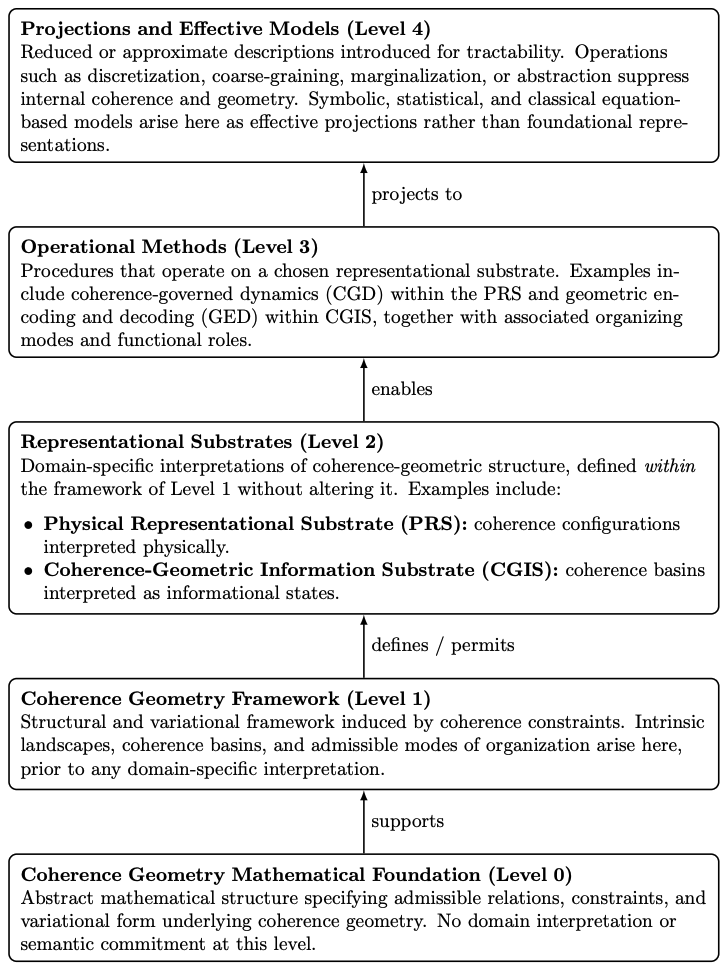
Level 0 — Coherence Geometry Mathematical Foundation. Specifies abstract relational structure, admissible configurations, and constraint organization underlying coherence geometry. The structure may be expressed in geometric form (configuration spaces, curvature, variational landscapes) or in algebraic form (operators, transformations, compositional relations). These are equivalent descriptions of the same underlying foundation.
Level 1 — Coherence-Geometric Framework. Provides the structural and variational organization of coupled configurations under shared coherence constraints. Intrinsic geometric structure arises here — coherence basins, relational landscapes, admissible modes of organization — prior to domain-specific interpretation.
Level 2 — Representational Substrates. Assigns domain-specific meaning to coherence-governed states without altering their underlying structure. The Physical Representational Substrate (PRS) interprets coherence-geometric states dynamically; the Coherence-Geometric Information Substrate (CGIS) interprets the same structure informationally. These substrates differ in interpretation, not in foundation.
Level 3 — Operational Methods. Specifies how states within a chosen substrate are used, evolved, stabilized, propagated, or recovered. Within the PRS, coherence-governed dynamics (CGD) define how configurations evolve through coherence constraints. Within CGIS, geometric encoding and decoding (GED) define how configurations are represented and organized under perturbation.
Level 4 — Projection and Effective Models. Reduced or effective descriptions introduced for tractability. Projection operations such as discretization, coarse-graining, marginalization, or abstraction map coherence-geometric structure onto symbolic, statistical, or classical equation-based models. These models suppress internal coupling and geometry; they function as approximations rather than foundational descriptions.
Within this layered view, physical theories, informational models, and inference frameworks are situated as different operational regimes and projections of a shared coherence-geometric structure, rather than as independent foundations.
Substrates and Operational Methods
The two representational substrates introduced at Level 2 — physical and informational — share a common underlying organization but differ in how that organization is interpreted and operated upon. Within each substrate, organization proceeds through a small number of recurring modes.
▸ Physical Representational Substrate (PRS)
The Physical Representational Substrate interprets coherence geometry dynamically, treating coherence-governed states as physically instantiated configurations whose evolution unfolds in time and space. Within the PRS, coherence constraints manifest as transport, aggregation, instability, organization, and pattern formation.
Within this substrate, coherence-governed dynamics (CGD) describe how structure, transport, and organization arise from coherence constraints acting on coupled fields. These dynamics admit three modes of expression corresponding to how coherence curvature is resolved over time:
- Curvature-Driven Amplitude Relaxation (CDAR). Stabilization and basin formation through dissipative settling. Produces coherent structure, pattern formation, and equilibrium-like configurations.
- Curvature-Driven Activation Dynamics (CDAD). Sustained activity, growth, and decay arising from feedback between coupled fields. Produces ignition, oscillation, and self-sustained dynamics.
- Curvature-Driven Transport (CDT). Redistribution of coherence through flow-like processes, giving rise to advection, circulation, and effective conservation behavior.
These modes do not constitute separate frameworks. They are distinct expressions of the same underlying curvature-driven dynamics. Observed physical systems typically reflect one dominant mode or a combination of modes acting in concert.
▸ Coherence-Geometric Information Substrate (CGIS)
The Coherence-Geometric Information Substrate interprets the same coherence-governed structures informationally. Within CGIS, stable coherence basins correspond to informational states, perturbations correspond to noise or uncertainty, and relaxation dynamics correspond to inference, recovery, or decoding.
Within this substrate, geometric encoding and decoding (GED) defines how configurations are represented, propagated, and resolved under perturbation, admitting three functional roles:
- Coherence-Driven Information Storage (CDIS). Persistence of configurations within stable coherence basins, providing a geometric basis for memory and representational stability.
- Coherence-Driven Information Transmission (CDIT). Propagation of configurations across channels or domains, corresponding to communication and signal transfer.
- Coherence-Driven Inference and Recovery (CDIR). Relaxation of perturbed configurations toward coherent basins, giving rise to decoding, error correction, and inference.
These roles are not separate mechanisms. They are distinct functional expressions of the same underlying coherence structure under informational interpretation.
▸ Correspondence Between Physical and Informational Regimes
The organizing modes observed in the PRS and the functional roles observed in CGIS are not independent. They reflect parallel expressions of the same underlying coherence structure under different interpretations:
| Physical Mode (PRS) | Informational Role (CGIS) | Interpretation |
|---|---|---|
| CDAR (Relaxation) | CDIR (Inference / Recovery) | Convergence to coherent basins |
| CDAD (Activation) | CDIS (Storage / Persistence) | Sustained coherent state |
| CDT (Transport) | CDIT (Transmission) | Propagation across domain |
While these correspondences are structural rather than identical, they highlight a shared coherence-based organization underlying both physical dynamics and informational processes. Physical systems express these modes through evolution in space and time; informational systems express them through persistence, communication, and recovery of structured representations.
Generators, Organizers, and Projectors
Confusion in modeling and explanation often arises not from disagreement about underlying structure, but from conflating distinct roles played by different components of a workflow. Three descriptive roles clarify this:
- A generator is any process, perturbation, boundary condition, or initialization that excites or explores the state space of a chosen substrate. Generators supply variation, energy, or asymmetry, but do not themselves determine the organizing structure of the resulting configuration.
- An organizer is the intrinsic coherence-governed mechanism through which structure is stabilized, sustained, or redistributed. Organizers arise from a substrate’s variational and geometric constraints.
- A projector is any mapping or representation that reports organized coherence-geometric states in a reduced, conventional, or externally interpretable form.
Distinct generators applied to the same substrate may produce qualitatively different outcomes while remaining subject to the same organizing principles. Many classical theories and models function as projective descriptions of deeper coherence-governed organization rather than as foundational mechanisms.
Projection
Projection maps coherence-geometric structure onto reduced descriptions suited for tractable analysis or implementation. It may take the form of discretization, coarse-graining, marginalization, abstraction, or feature extraction.
Projection does not invalidate the underlying structure. It produces effective models that are accurate within their intended regime. Symbolic models, independent-channel assumptions, and statistical abstractions typically arise at Level 4, after projection has been applied.
What is lost through projection is not correctness, but access to the full coherence-geometric structure that enables stability, robustness, and recovery prior to discretization.
Position of Coherence Geometry
Coherence geometry does not replace symbolic, statistical, or physical frameworks. It specifies the structural substrate within which such frameworks may be constructed.
When coherence structure is retained, substrates such as PRS and CGIS support coherence-governed organization, including physical dynamics (CGD) and informational processes (GED). When structure is suppressed through projection, symbolic and probabilistic models provide effective descriptions.
This perspective explains how coherence geometry can simultaneously underlie physical theories, informational models, and control frameworks without contradiction. Differences between approaches reflect differences in layer, not disagreement about underlying structure.
For how this layered organization positions specific established frameworks — physical theories, information theory, inference and learning, control, and distributed systems — see Positioning Relative to Established Frameworks.
Note: The terms Coherence Geometry or Coherence Algebra may also appear in unrelated academic work. Unless otherwise indicated, references throughout this site refer to the framework documented by the Coherence Geometry Institute.