

Research
This section contains the research corpus of Coherence Geometry, including domain-based investigations, structured Seed Notes, formal Publications, and selected Patents. Materials are organized by scientific domain and research topic, allowing readers to explore the current research footprint of the framework across multiple fields and levels of technical depth.
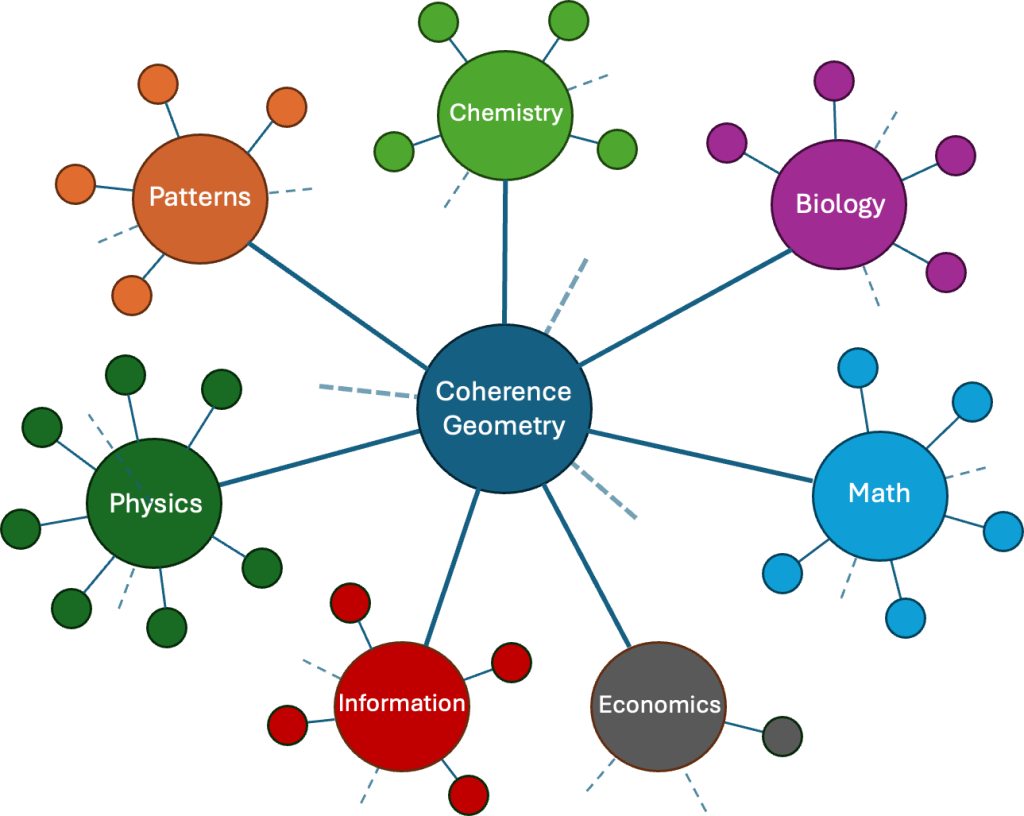
Coherence Geometry research footprint
The diagram above illustrates the current research footprint of Coherence Geometry across scientific domains. Each domain hub represents a field of investigation, while surrounding spokes indicate active research topics and areas of ongoing exploration. Dotted lines indicate possible directions for future expansion.
Start exploring the framework through its scientific domains.
Research organized by scientific and technical field, including both foundational theory and domain-specific results. These pages gather related topics, Seed Notes, and associated materials for structured exploration of the framework within each area.
Descriptions and diagrams explaining how the Coherence Geometry framework and its research materials are organized, including the relationships among domains, topics, Seed Notes, and publications.
Complete technical papers and reports released when results are sufficiently mature, protected, or published through external venues.
Records of protected mechanisms and applications associated with Coherence Geometry.
Together, these materials form a layered technical record spanning foundational construction, domain development, and formal disclosures.
How to Evaluate This Work
Coherence Geometry is organized around a central test: closure. If the framework is mathematically closed in the sense claimed, then known physical, informational, computational, and structural regimes should appear as projections, limits, or constrained forms of the same underlying coherence structure.
A decisive challenge to the framework would therefore identify a failure of closure, a broken projection, an incompatible invariant, or a class of phenomena that cannot be represented within the coherence formalism.
The Institute welcomes such work. Testing the limits of closure is one of the central research tasks of Coherence Geometry. Finding the boundary of the framework, identifying where a projection fails, or showing where closure does not hold would be a meaningful contribution to the development of the field. The Coherence Closure Problem is one way we’ve tried to express that quest mathematically.