

Transformations
It all starts with a child’s question: “What’s an element?”
From that simple curiosity, a hidden world begins to take shape. Every element — hydrogen, oxygen, gold — holds a configuration it can shift into when it’s ready to bond with others. We wondered what an element might look like inside — if we could actually observe how it decides upon its own strange and exotic inner identity. In this episode of Coherent Wonder, a Coherence Geometry simulation reveals how smooth, spherical clouds shift and reshape — uncovering the patterns that atoms assume before they ever start to bond.
Dad and son are soon distracted and mesmerized by the unfolding show, watching these luminous, shape-shifting forms that seem almost alive — as if nature itself were performing its own version of Transformers.
A Deeper Look
When we ran these Coherence Geometry simulations, something unexpected happened. Atomic orbitals — those familiar shapes from textbooks — didn’t need to be drawn. They just seemed to form themselves naturally. And we didn’t need to resort to Schrödinger’s equation at all.
(Yeah, we know. We’re thinking that too: “How do you get atomic orbitals without Schrödinger?!”)
Each structure began as a sphere, then gradually reshaped under lightly applied stress, settling into the same p, d, f, and g forms we’ve all seen but never actually watched emerge. This isn’t animation or artistry — it’s simply a numerical process unfolding in real time, matter finding its own balance.
The transition from symmetry to structure looks continuous and directional, not random. There’s a definite process underway. To capture this process in action, Figure 1 shows what seem to be representative orbitals from each shell — p, d, f, and g — shown in both intermediate and final states of formation.
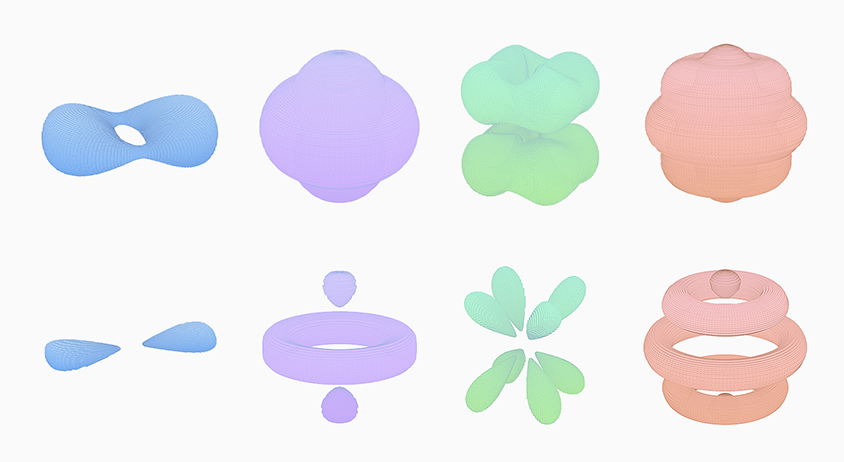
Figure 1: p, d, f, and g orbitals emerging during the simulation — shown in the process of formation (top row) and in their final, stabilized forms (bottom row).
We don’t yet know what this means. Maybe no one does — not yet, anyway. But it feels like the beginning of a new kind of conversation about how atoms, and maybe all of nature, find their order. We hope it encourages others to join in that conversation with us.
If this episode piqued your curiosity, you’ll probably want to see where it leads. In Coming Together, we explore how those emerging orbitals respond when they come close enough to feel each other’s presence.