

Horizon-Like Emission from Curvature-Bound Coherence Fields
Internal ID: CGI-RSR-000023
Author(s): Barry L. Petersen
Document Type: Research Paper
Publication Date: May 2026
Original Creation Date: February 27, 2026
Revised Document Date: May 18, 2026
Status: Public
Domains: Physics
Sub-Domain: Cosmology, Black Holes and Horizon Structure
Research Topics: Hawking Radiation, Black holes, Noether theorem
Abstract
We investigate horizon-like emission from curvature-regulated coherence fields within the Coherence Geometry (CG) framework. Using a multi-phase Lagrangian that incorporates curvature stiffness and phase-locking interactions, we numerically simulate the relaxation of a confined coherence region bounded by a curvature rim. The resulting outward flux exhibits robust inverse-square scaling with boundary radius,
consistent across all simulated geometries. This scaling arises from local geometric interactions and conserved exterior flux, without invoking statistical, quantum, or thermodynamic assumptions. The results demonstrate that curvature-trapping interfaces in deterministic coherence dynamics naturally produce geometric emission with universal dilution behavior. We discuss the structural relationship between this mechanism and horizon emission phenomena in semiclassical settings.
Available Document
DOI: 10.5281/zenodo.20266162
Citation:
Petersen, B. L. (2026). Horizon-Like Emission from Curvature-Bound Coherence Fields. Zenodo. https://doi.org/10.5281/zenodo.20266162
Representative Figure
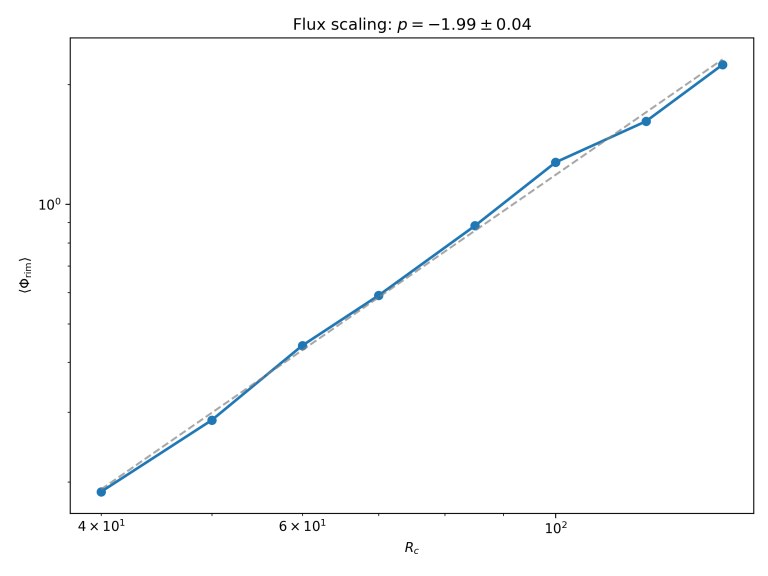
Log–log scaling of average rim power versus radius. The best-fit exponent p = 1.99 \( \pm \) .04 demonstrates that the flux follows an inverse-square dependence, consistent with geometric propagation of curvature energy.
Source Code and Supporting Materials
Computational materials:
This Zenodo record includes research-artifact notebooks and data associated with
the numerical results in the paper. These materials are provided for inspection,
transparency, and reproducibility support, but are not packaged as maintained
software.
Files included:
cg_action_flux_radial_GOLD.ipynb
Research notebook implementing the radial CG action-flux simulator. This notebook generates rim-intensity / rim-power data for a selected curvature rim radius and saves output files and plots to a local folder. The notebook can be repeated for each radius used in the study. Generated 2D image frames are used in the paper to illustrate the radiative effect.
rim_power_combiner.ipynb
Utility notebook that combines the individual rim-power CSV files generated for each radius into the combined dataset rim_power_all.csv.
analyze_rim_flux.ipynb
Analysis notebook that reads rim_power_all.csv and generates the main line and scatter plots reported in the paper, saving the resulting figures to a local folder.
rim_power_all.csv
Combined rim-power dataset used by analyze_rim_flux.ipynb. This file is included as a shortcut so that readers can reproduce the analysis plots without rerunning the full simulator for every radius.
rim_power_output.zip
Archive of the original per-radius output data collected during the study. These files can be used with rim_power_combiner.ipynb to regenerate rim_power_all.csv.
Workflow summary:
cg_action_flux_radial_GOLD.ipynb
-> per-radius rim-power output files and 2D emission plots
-> rim_power_combiner.ipynb
-> rim_power_all.csv
-> analyze_rim_flux.ipynb
-> paper plots
Reproducibility note:
The notebooks are provided as research artifacts associated with the paper, not as a maintained software package. They may require local path adjustments, environment setup, and manual selection of radius values before execution. The included rim_power_all.csv file allows the main analysis plots to be reproduced without rerunning the full simulator.
Code and data availability:
The Zenodo record includes the simulator notebook, combiner notebook, analysis notebook, combined rim-power dataset, and original per-radius output archive used for the figures and scaling analysis. No public technical support is implied.
Summary and Notes
Scope:
This document should be read as a CG-native horizon-like emission study focused on geometric flux generation and inverse-square dilution. The paper does not reproduce the standard semiclassical quantum-field-theoretic derivation of Hawking radiation. Instead, it uses deterministic curvature-bound coherence dynamics to show how horizon-like interfaces can generate outward radiative flux with (R_c^{-2}) scaling.
The result is supported by a detailed energy-flux formulation, including stress-energy and Noether-current derivations, and by numerical notebooks that generate the rim-flux scaling data and time-resolved emission frames.
The included notebooks also generate time-resolved visual frames of the radiating coherence field, making the emission process inspectable as a geometric evolution rather than only as an inferred statistical or semiclassical effect.
Framework context:
The paper belongs to the Physics / Black Holes and Horizon Structure or Cosmology areas of the Coherence Geometry research corpus. It uses CG amplitude-phase field dynamics to model curvature-bound coherence regions, trapping interfaces, and outward-propagating flux.
Related Work
Related research:
Petersen, B. L. (2026). Planck’s Constant as a Coherence Quantization from Phase Geometry. Zenodo. https://doi.org/10.5281/zenodo.20257619
Related framework:
Petersen, B. L. (2026). Coherence Geometry Foundations, Part I: Orientation,
Closure, and Algebraic Foundations (Version 0.1). Zenodo.
https://doi.org/10.5281/zenodo.20156532
Petersen, B. L. (2026). Coherence Geometry Foundations, Part II: Physical
Projections (Version 0.1). Zenodo.
https://doi.org/10.5281/zenodo.20156997