

Coherence Across Chemical Structure
One of the clearest patterns to emerge from Coherence Geometry (CG) research is the repeated appearance of related coherence-driven organizational behavior across multiple domains and scales of structure formation. This progression became especially difficult to ignore in chemistry.
Across several CG investigations, related coherence-based mechanisms have been explored in connection with:
- localized orbital-like coherent structure,
- atomic and molecular bonding behavior,
- recursive crystal and snowflake growth,
- RNA-like self-folding strand organization,
- DNA-like duplex helicity and recursive strand transport,
- and protein folding and coherent core formation.
These systems are normally treated as belonging to different conceptual layers of chemistry and molecular science. Orbitals, bonding, crystallization, protein folding, DNA helicity, and RNA folding are usually modeled using different mathematical descriptions and different effective physical assumptions.
Despite being modeled through very different mathematical and physical descriptions, several recurring organizational themes appeared across the corresponding CG investigations:
- coherence stabilization,
- compatibility constraints,
- recursive transport,
- geometric organization,
- variational relaxation,
- emergence of stable large-scale structure from local interactions.
Within the CG framework, these systems can often be interpreted through a common coherence-geometric lens. Orbital-like states appear as localized coherent spatial modes. Bonding appears when coherent structures enter shared stabilization. Crystal structures emerge through recursive geometric accretion. DNA-like duplex helicity emerges through coherence alignment, transport, and recursive geometric propagation. RNA-like folds emerge through self-compatible coherence closure within a single informational strand. Protein folding appears through constrained coherence relaxation and core formation.
Chemical Structure Across Scale
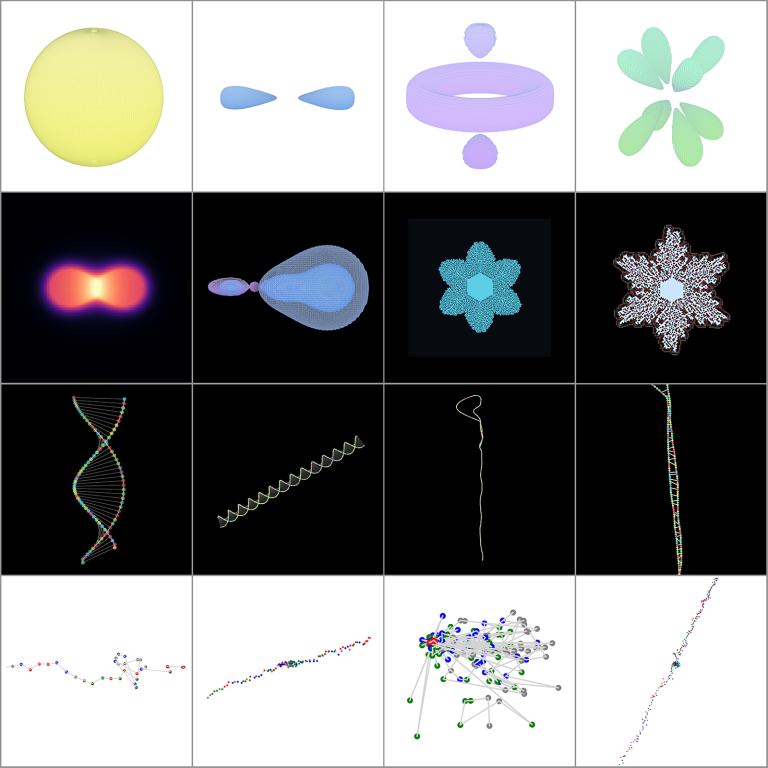
A visual progression of coherence-driven chemical structure across increasing levels of organization. The top row shows orbital-like coherence states, from spherical localization to higher-order d- and f-orbital directional modes. The second row moves from s-s and s-p bonding interactions to compact and dendritic crystal-growth regimes. The third row shows nucleic-acid organization, including DNA duplex growth and RNA folding/zipper structure. The bottom row shows protein-like folding, from early local organization through dense 200-residue folded states and a mid-fold snapshot of larger 500-residue coherent packing. Although these systems were developed independently and address different levels of chemical organization, the panels reveal recurring patterns of coherence, constraint, transport, folding, and geometric stabilization without imposing the final forms in advance.
The important observation is not merely that these systems produce interesting geometry. The stronger observation is that related coherence mechanisms appear capable of generating stable organization repeatedly across several connected levels of chemical structure. One consequence of this perspective is that increasing structural complexity often appears as an extension of existing organizational behavior rather than the introduction of entirely new rules. In several CG investigations, the same underlying coherence-driven mechanisms continue to operate as system size increases, producing larger and more elaborate structures without requiring the final form to be specified in advance.
The larger-scale folding example below illustrates this recurring pattern. Despite the substantially increased chain length, local clustering, intermediate-scale folding, and coherent core formation continue to emerge through the same underlying interaction mechanisms.
Protein Folding Across Scale
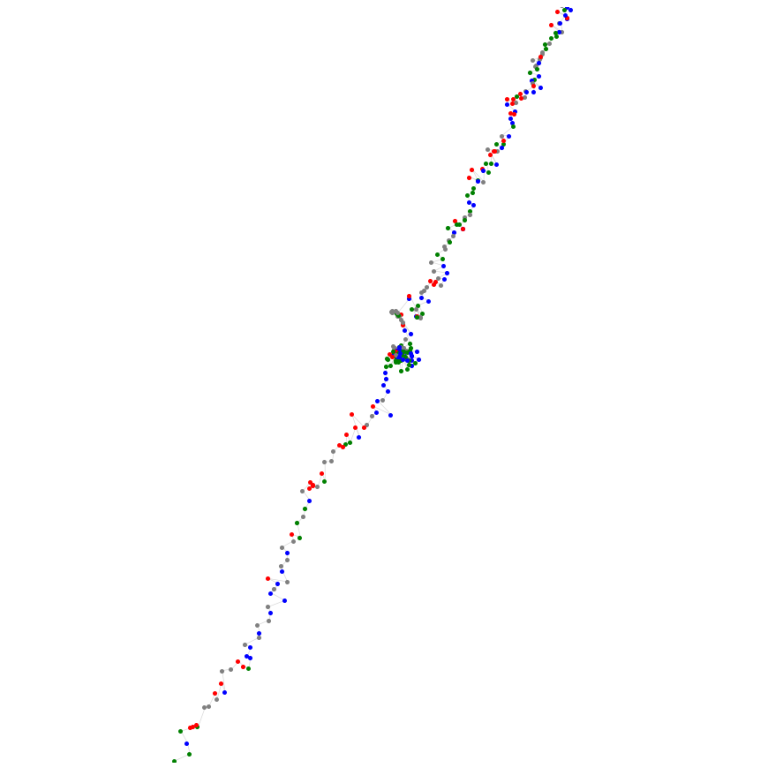
Expanded view of the 500-residue coherence-driven folding simulation. Despite the increased chain length, organization emerges through the same local interaction rules, producing coherent 3D folding behavior across a substantially larger structure. The image captures simultaneous organization across multiple scales, including local clustering, intermediate-scale folding, and long-range recruitment toward coherent core formation.
Recent CG work on duplex helicity provides a particularly simple illustration of this broader pattern. In that construction, a local coherence state interacts with a coherence operator to generate transport, and the accumulated transport produces a stable double-helical structure. Although developed as a minimal transport model rather than a biochemical simulation, the example demonstrates how recognizable biological geometry can emerge from local coherence dynamics and recursive growth.
Taken together, these investigations suggest that coherence-based descriptions may provide a useful way of relating organizational behavior across multiple levels of chemical structure. Across the chemical and biological systems investigated so far, recurring coherence mechanisms offer an interesting perspective for connecting structures that are often treated as separate kinds of phenomena.
Illustrative Example
Emergent Duplex Helicity from Coherence Alignment and Transport
A minimal demonstration of coherence alignment, response, transport, and emergent geometric structure.
Related Research
- Atomic Orbitals via Coherence Geometry
- Atomic Bonding via Coherence Geometry
- Deterministic Protein Folding from Coherence Fields
- Snowflake Morphogeneisis via Coherence Geometry
- RNA Folding via Coherence Geometry