

A Conceptual Overview of the Coherence-Geometric Framework: Organizational Structure, Terminology, and Projection
Internal ID: CGI-REF-0001
Author(s): Barry L. Petersen, Robert K. Johnson, and Alan E. Bruno
Document Type: Reference Document
Publication Date: September 12, 2026
Original Creation Date: March 24, 2026
Revised Document Date: September 12, 2026
Status: Public
Domains: Information, General
Sub-Domain: Framework Organization and Terminology
Research Topics: Coherence-Geometric Terminology
Abstract
This document is an organizational and terminological reference for the Coherence Geometry Institute (CGI). It does not introduce new axioms or technical results, but records the conceptual structure, naming conventions, and interpretive distinctions used across the CGI canon and associated works. Alternative formulations and terminology may exist, but references to coherence geometry within CGI publications are grounded in the definitions and organizational structure presented here.
Available Document
Citation:
Petersen, B. L., Johnson, R. K., & Bruno, A. E. (2026). A Conceptual Overview of the Coherence-Geometric Framework: Organizational Structure, Terminology, and Projection (Version 1.0). Zenodo. https://doi.org/10.5281/zenodo.22720726
Representative Figure
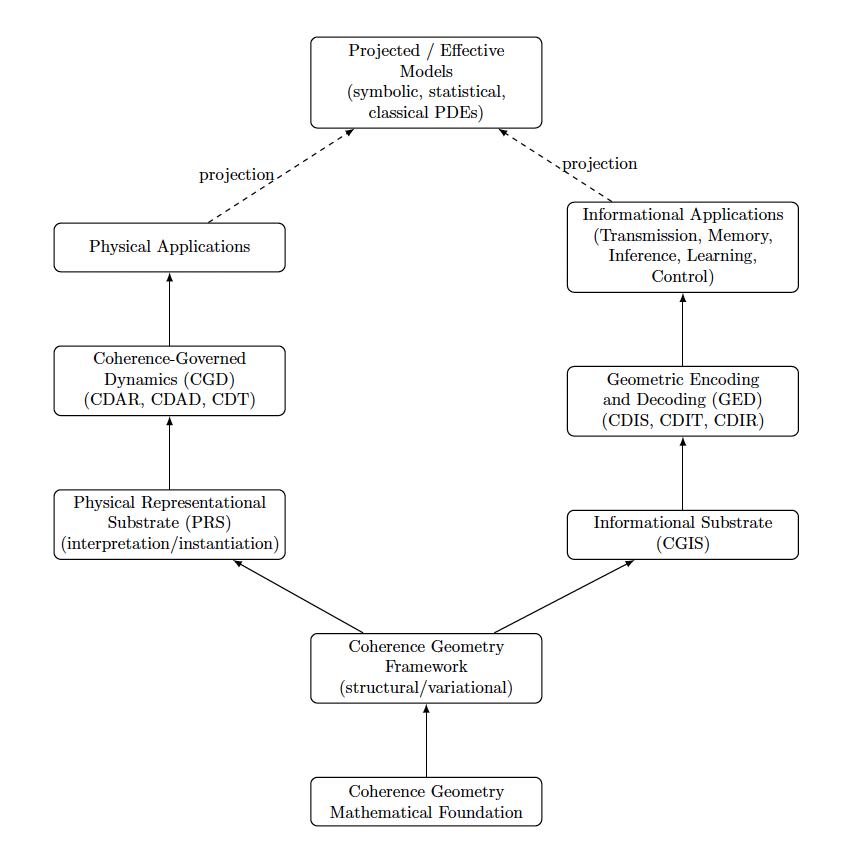
High-level organization of the Coherence Geometry program.
The Coherence Geometry Mathematical Foundation supports the coherence-geometric framework at the structural and variational level. From this common basis, domain-specific representational substrates provide distinct physical and informational interpretations: the Physical Representational Substrate (PRS) and the Coherence-Geometric Informational Substrate (CGIS). Within the PRS, coherence-governed dynamics describe physical organization, relaxation, transport, and pattern formation. Within CGIS, Geometric Encoding and Decoding (GED) provides an operational language for informational representation, persistence, transmission, perturbation, and recovery. Projected or effective models, including symbolic, statistical, and classical equation-based descriptions, arise as higher-level descriptions of these underlying coherence-governed regimes.
Source Code and Supporting Materials
No source code is required for this reference document.
Primary file:A_Conceptual_Overview_of_the_Coherence_Geometric_Framework_260912.pdf
Version 1.0 archival reference document.
A README file accompanying the Zenodo deposit records document provenance, scope, citation information, and archival metadata.
Summary and Notes
Scope:
This document organizes Coherence Geometry across several conceptual levels, beginning with the mathematical foundation and general coherence-governed framework and extending through representational substrates, operational methods, and projected or effective descriptions.
Particular attention is given to the distinction between the Physical Representational Substrate (PRS) and the Coherence-Geometric Informational Substrate (CGIS). These are treated as distinct interpretive descriptions of a common underlying coherence-governed organization rather than necessarily distinct underlying sources.
The document also locates major CGI method families within this structure. On the physical side, these include coherence-governed dynamics and associated relaxation, transport, and pattern-forming processes. On the informational side, they include Geometric Encoding and Decoding (GED) and its associated roles in storage, transmission, inference, recovery, learning, and control.
The purpose of the document is not to introduce a new layer of theory, but to provide a stable organizational map for reading and relating the larger Coherence Geometry research corpus.
Related Work
Related framework:
Petersen, B. L. (2026). Coherence Geometry Foundations, Part I: Orientation,
Closure, and Algebraic Foundations (Version 0.1). Zenodo.
https://doi.org/10.5281/zenodo.20156531
Petersen, B. L. (2026). Coherence Geometry Foundations, Part II: Physical
Projections (Version 0.2). Zenodo.
https://doi.org/10.5281/zenodo.20156996