

Emergent Duplex Helicity from Coherence Alignment and Transport
Internal ID: CGI-RSR-000028
Author(s): Barry L. Petersen
Document Type: Research Paper
Publication Date: June 2026
Original Creation Date: June 9, 2026
Status: Public
Domains: Biology, Chemistry, Physics
Sub-Domain: Molecular Structure, DNA
Research Topics: DNA, Duplex helicity, Transport, Operator dynamics
Abstract
Helical structures are commonly modeled by prescribing a rotational geometry, a preferred twist angle, or an equivalent geometric construction rule. In this work, we investigate an alternative approach in which helicity emerges from local coherence dynamics rather than from an explicitly imposed helical instruction. We introduce a minimal duplex model consisting of a three-channel coherence state and a fixed (\( 3\times3 \)) coherence operator. Admissible local states align with the coherence mode supported by the operator. A transport observable is obtained by projecting the resulting response onto an axis determined by the antisymmetric part of the operator, and the resulting transport increment is applied recursively as a local frame rotation during duplex growth. The construction produces stable duplex helicity without an imposed global helical scaffold, target curve, or prescribed twist angle. Diagnostic examples demonstrate complete transport cycles, persistent long-range helical organization, and operator-controlled handedness. Numerical experiments further indicate that a broad range of admissible initial states converge toward nearly identical response directions, implying that the resulting transport behavior is determined primarily by the operator rather than by the particular incoming state. Although the model is intended as a minimal transport construction rather than a realistic biochemical simulation, it illustrates how local coherence dynamics can generate observable geometric structure through recursive transport. In this framework, the helical twist appears as a derived consequence of the operator-supported transport dynamics rather than as an externally prescribed geometric parameter.
Available Document
DOI: 10.5281/zenodo.20607906
Citation:
Petersen, B. L. (2026). Emergent Duplex Helicity from Coherence Alignment and Transport. Zenodo. https://doi.org/10.5281/zenodo.20607906
Representative Figure
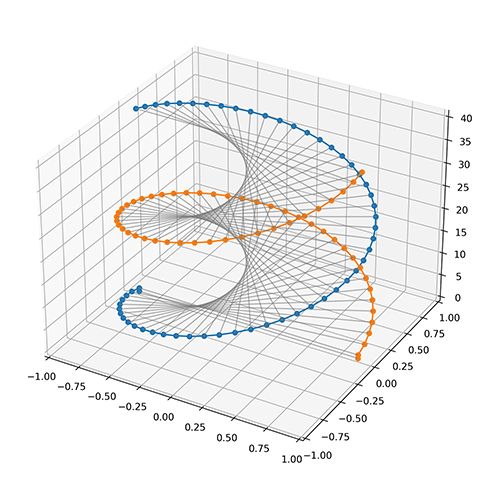
3D numerically simulated image of helicity emerging from local coherence dynamics.
Source Code and Supporting Materials
Notebook availability:
Three Jupyter notebooks are included as research artifacts associated with the
paper. Two notebooks generate the video frames and visualizations used for the
website and paper imagery, while one notebook generates the diagnostic plots
shown in the paper.
Files included:
- DNA_Formation_Video_Frames_Creator-v8.ipynb
Jupyter notebook used to generate longer duplex-strand video frames and site
visualizations associated with the paper. This notebook produces extended
recursive-growth structures showing persistent long-range helical organization. - DNA_Formation_Video_Frames_Creator-Initial-v8.ipynb
Jupyter notebook used to generate early-growth duplex video frames and the
early-growth DNA image used in the paper. This notebook focuses on the initial
formation stage of the recursive duplex-growth process. - Minimal_Recursive_Duplex_Growth_v8_Plots.ipynb
Jupyter notebook used to generate the diagnostic figures shown in the paper,
including plots associated with recursive duplex growth, transport behavior,
response direction, operator-controlled handedness, and convergence of the
state, response, and transport observables.
The notebooks are provided for inspection, experimentation, figure-generation
context, and reproducibility support. They are not packaged as maintained
software. Local paths, environment setup, plotting/video options, frame export
settings, and parameter choices may require adjustment. No public technical
support is implied.
Summary and Notes
PDF research paper describing the minimal duplex transport model, three-channel coherence state, fixed coherence operator, antisymmetric transport axis,
recursive frame rotation, diagnostic examples, long-range helical organization,
operator-controlled handedness, and convergence behavior across admissible
initial states.
Related Work
Petersen, B. L. (2026). Atomic Orbitals via Coherence Geometry. Zenodo.
https://doi.org/10.5281/zenodo.20270492
Petersen, B. L. (2026). Atomic Bonding via Coherence Geometry. Zenodo.
https://doi.org/10.5281/zenodo.20287269
Petersen, B. L. (2026). Deterministic Protein Folding from Coherence Fields. Zenodo.
https://doi.org/10.5281/zenodo.20285351
Petersen, B. L. (2026). Coherence Geometry Foundations, Part I: Orientation,
Closure, and Algebraic Foundations (Version 0.1). Zenodo.
https://doi.org/10.5281/zenodo.20156532
Petersen, B. L. (2026). Coherence Geometry Foundations, Part II: Physical
Projections (Version 0.1). Zenodo.
https://doi.org/10.5281/zenodo.20156997