

Molecular Structure
This research area studies how biological molecular form may arise from coherence dynamics, local alignment, transport, and constraint. In Coherence Geometry, molecular structures are not treated only as fixed geometric templates, but as observable forms that can emerge from local coherence relations, response formation, frame transport, folding dynamics, and stability selection.
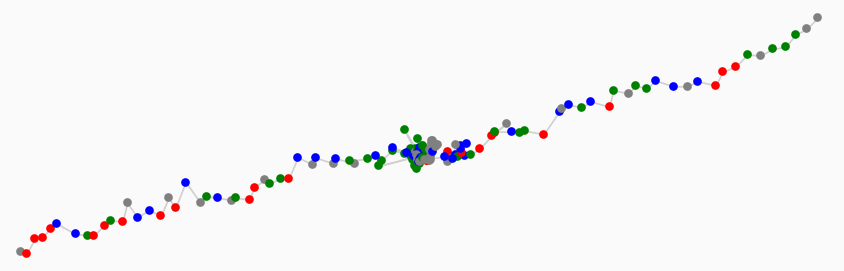
A simulated simple 200-residue protein, captured at a mid-stage of the folding process.
Papers in this area investigate structures such as protein folds, duplex helicity, RNA-like organization, molecular alignment, and coherent transport, asking how recognizable biological geometry can appear from local rules rather than from globally prescribed shape.
Publication List
-
Emergent Duplex Helicity from Coherence Alignment and Transport
CGI-RSR-000028 | Helical structures are commonly modeled by prescribing a rotational geometry, a preferred twist angle, or an equivalent geometric construction rule. In this work, we investigate an alternative approach in which helicity emerges from local coherence dynamics rather than from an explicitly imposed helical instruction.
-
Deterministic Protein Folding from Coherence Fields
CGI-RSR-000026 | We present a deterministic, geometry-based model of protein folding using a novel variational framework called coherence geometry (CG). In this system, residues are modeled as local phase agents embedded in a spatial field, each carrying internal biases that reflect their chemical identities. The chain folds not through stochastic search or learned potentials, but…