

Atomic Orbitals via Coherence Geometry
Internal ID: CGI-RSR-000024
Author(s): Barry L. Petersen
Document Type: Research Paper
Publication Date: May 2026
Original Creation Date: September 7, 2025
Revised Document Date: N/A
Status: Public
Domains: Chemistry, Physics
Sub-Domain: Quantum Chemistry
Research Topics: Atomic orbitals, orbital morphogenesis, nodal topology
Abstract
This paper introduces a geometric framework for the spontaneous emergence of atomic orbital structures from curvature-driven field dynamics, independent of quantum mechanical postulates. Within Petersen’s Coherence Geometry (CG) framework, orbitals arise as metastable attractors in a real-valued amplitude field, shaped by angular tension gradients and curvature bifurcations. Starting from isotropic initial conditions, the system evolves toward familiar nodal geometries such as \(p_x\), \(p_z\), \(d_{z^2}\), \(f_{z^3}\), and \(g_{z^4}\)—all without imposing eigenfunction bases, boundary constraints, or complex-valued wavefunctions. The resulting orbital shapes are not approximations or heuristic visualizations, but precise topological equivalents of those derived from the Schrödinger equation. Each configuration reproduces the correct number, orientation, and type of nodal surfaces expected for its orbital class. By encoding phase relationships and spatial distortion through geometric tension, the CG framework offers a physically grounded alternative to conventional orbital theory—unifying orbital formation and structure under a single real-valued dynamical principle. These results suggest the existence of a deeper geometric substrate underlying orbital identity—one in which nodal topology emerges not from imposed quantization, but from the spontaneous self-organization of curvature fields. This approach provides a new lens for understanding atomic structure and may lay the groundwork for extending geometric methods into bonding, spin, and unified field modeling.
Representative Figure
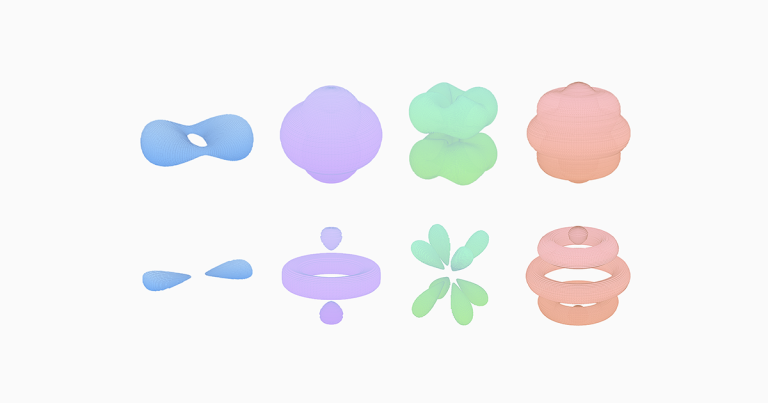
Spontaneous emergence of atomic orbital structures from curvature-driven field dynamics
Available Document
DOI: 10.5281/zenodo.20270492
Citation:
Petersen, B. L. (2026). Atomic Orbitals via Coherence Geometry. Zenodo. https://doi.org/10.5281/zenodo.20270492
Source Code and Supporting Materials
Simulation code is not included in this release. The simulations and visual outputs are reported in the paper, but the underlying computational notebooks and scripts are internal research artifacts and are not packaged as public software. No public technical support is implied.
Summary and Notes
Core result:
Starting from isotropic or minimally structured initial conditions, the CG relaxation process produces recognizable nodal orbital geometries without inserting standard quantum-mechanical orbital equations directly. The resulting forms reproduce key topological features associated with conventional orbital classes, including nodal number, orientation, and surface type.
Scope:
This document should be read as a geometric and simulation-driven CG formulation of orbital morphogenesis. It focuses on the emergence of orbital identity and nodal topology from coherence-geometric relaxation, rather than on a complete quantitative treatment of all electronic-structure phenomena. Broader chemistry-scale modeling, spectral calibration, and predictive computational chemistry applications are left to future work.
Historical and framework context:
This paper is released in its original September 2025 form. It belongs to the early simulation-driven chemistry phase of the Coherence Geometry research corpus, before the later canon records and Foundations texts were fully organized. Some internal references reflect the framework references available at the time of writing. Later canon and Foundations materials provide the current public reference layer for the underlying CG formalism.
Relation to later work:
This orbital paper is paired conceptually with later CG chemistry work on atomic bonding, where orbital-like coherence structures are allowed to interact and form bond-like configurations. The present paper focuses on orbital identity and morphogenesis; the bonding paper develops interaction and structural coupling between such forms.
Related Work
Petersen, B. L. (2026). A Multi-Phase Extension of Complex Numbers and the Global Coherence Theorem. Zenodo. https://doi.org/10.5281/zenodo.20116654
Petersen, B. L. (2026). Mathematical Foundations of Coherence Formation and Stability. Zenodo. https://doi.org/10.5281/zenodo.20116648
Petersen, B. L., & Johnson, R. K. (2026). A Variational–Relaxation Framework for Coherence-Driven Structure Formation. Zenodo. https://doi.org/10.5281/zenodo.20120588
Petersen, B. L. (2026). Coherence Geometry Foundations, Part I: Orientation,
Closure, and Algebraic Foundations (Version 0.1). Zenodo.
https://doi.org/10.5281/zenodo.20156532
Petersen, B. L. (2026). Coherence Geometry Foundations, Part II: Physical
Projections (Version 0.1). Zenodo.
https://doi.org/10.5281/zenodo.20156997