

Horizon-Like Emission from Curvature-Bound Coherence Fields
Internal ID: CGI-RSR-000023
Author(s): Barry L. Petersen
Document Type: Research Paper
Publication Date: May 2026
Original Creation Date: February 27, 2026
Revised Document Date: September 3, 2026
Status: Public
Domains: Physics
Sub-Domain: Cosmology, Black Holes and Horizon Structure
Research Topics: Hawking Radiation, Black holes, Noether Energy Current, Scale Covariance, Deterministic Field Dynamics
Abstract
We investigate horizon-like emission from a deterministic, curvature-bound coherence field within the Coherence Geometry (CG) framework. A reduced multi-phase model with ordinary wave propagation, phase locking, and higher-spatial-derivative curvature stiffness is evolved outside a prescribed spherical core. Energy transport is measured using the complete radial Noether current.
The radius dependence is formulated as a scale-covariant family with fixed conservative source/excitation action. This gives the analytic scaling hierarchy\[ E\propto R^{-1}, \qquad P\propto R^{-2}, \qquad S_r^{\mathrm N}\propto R^{-4}, \] where \(P\) is the area-integrated power and \(S_r^{\mathrm N}\) is the local radial energy-flux density.
Numerical simulations over five radii reproduce the predicted full-waveform covariance to residuals of order \(10^{-10}\). A separate noise-free control shows ordered outward propagation through successive exterior radii at an effective speed close to the characteristic field speed.
The inverse-square power law therefore arises from the scale covariance of the fixed-action source-response family rather than from ordinary spherical dilution of a radius-independent luminosity. No vacuum prescription, stochastic forcing, thermal spectrum, particle-creation rule, or thermodynamic assumption is introduced. The results show that boundary-localized response, outward energy transport, characteristic propagation, and inverse-square total-power scaling can all arise within a deterministic variational field system before additional quantum or statistical structure is imposed.
Available Document
DOI: 10.5281/zenodo.22282290
Citation:
Petersen, B. L. (2026). Horizon-Like Emission from Curvature-Bound Coherence Fields (Version 2.0). Zenodo. https://doi.org/10.5281/zenodo.22282290
Representative Figure
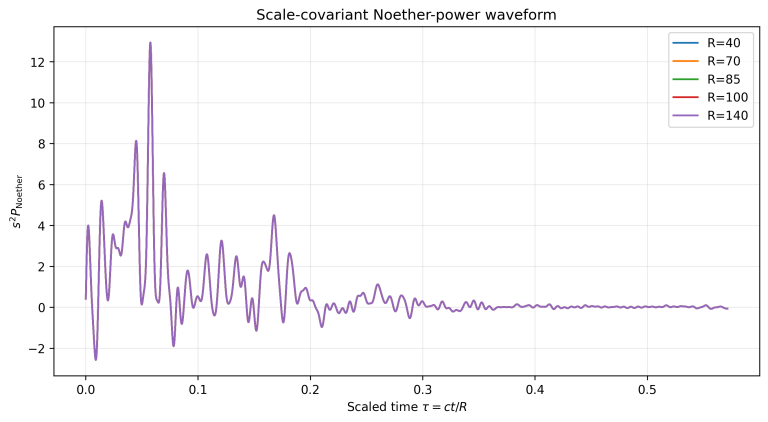
Scale-covariant collapse of the area-integrated radial Noether power for five radius-family members. Under fixed conservative source/excitation action, the predicted rescaling \(s^2P_R(\tau)\) collapses the independently evolved waveforms onto a common dimensionless response. Numerical residuals are of order \(10^{-10}\), verifying the analytic \(P\propto R^{-2}\) covariance.
Source Code and Supporting Materials
Computational materials:
The Zenodo record includes the numerical notebooks and data used to generate and verify the results reported in Version 2.0. These materials are provided for inspection, transparency, and reproducibility support, but are not packaged as maintained software.
Files included:
cg_action_flux_radial_GOLD_v02.ipynb
Primary numerical simulator for the radial multi-phase coherence field. The notebook evolves the curvature-stiffened field in spherical symmetry with a locked interior core, curvature-matching boundary condition, weak damping, and an outer absorbing sponge.
It generates the time-resolved Noether-flux and power data for the five-member scale-covariant radius family at\[ R=40,\;70,\;85,\;100,\;140. \]
The same notebook is also used for the \(R=140\) noise-free multi-detector transport control and can generate the spatial energy-density frames used in the paper.
Test_Collection.ipynb
Analysis and verification notebook for the numerical results. It performs the scaled-time comparison, full-waveform covariance tests, residual analysis, log-log scaling fits, invariant checks, radius-scaling plots, and the multi-detector transport-delay analysis reported in the paper.
Numerical data archive
The Zenodo record also includes the CSV outputs used by the analysis notebook, including the five scale-covariant radius calculations, their summary files, and the \(R=140\) noise-free transport-control data.
These archived outputs allow the quantitative analysis to be reproduced using the same numerical data reported in the paper without rerunning the full field simulation.
Workflow summary:
cg_action_flux_radial_GOLD_v02.ipynb
→ five scale-covariant field evolutions
→ time-series Noether-flux / power CSV files
→ per-radius summary CSV files
and
cg_action_flux_radial_GOLD_v02.ipynb
with the \(R=140\) noise-free transport-control configuration
→ multi-detector transport data
then
Test_Collection.ipynb
→ waveform covariance verification
→ \(R^{-1}\), \(R^{-2}\), and \(R^{-4}\) scaling tests
→ invariant checks
→ transport-delay analysis
→ paper plots
Reproducibility note:
The five primary calculations represent dilation-related members of the same dimensionless model. The dimensional parameters, spatial grid, time step, initial condition, damping, and boundary parameters transform with radius according to the scale-covariant construction derived in the paper.
The \(R=140\) noise-free calculation is an independent transport control used to isolate outward propagation from the distributed exterior noise present in the primary covariance runs.
Local path adjustments and environment setup may be required before running the notebooks.
Code and data availability:
The Zenodo record includes the simulator notebook, verification notebook, and numerical CSV outputs used for the Version 2.0 figures and scaling analysis. No public technical support is implied.
Summary and Notes
Scope:
This paper studies a deterministic response-level model of horizon-like emission within Coherence Geometry.
A prescribed spherical core defines a curvature-bound configuration, while the exterior field remains dynamical. The resulting response is analyzed using the complete Noether energy current rather than a phenomenological rim-flux diagnostic.
For a scale-covariant family normalized to fixed conservative source/excitation action, the model gives\[ E\propto R^{-1}, \qquad P\propto R^{-2}, \qquad S_r^{\mathrm N}\propto R^{-4}. \]
The five-radius numerical study verifies not only these scaling exponents but the stronger full-waveform covariance predicted analytically. A separate multi-detector control confirms ordered outward propagation at a speed close to the characteristic field speed.
The inverse-square result should therefore not be interpreted as ordinary geometric dilution of a fixed luminosity. It is a scaling property of the source-response family itself.
No vacuum prescription, stochastic forcing, particle-creation rule, thermal spectrum, or thermodynamic assumption is required for the particular radiative structures demonstrated here. Boundary-localized response, outward energy transport, characteristic propagation, and inverse-square total-power scaling all arise directly from deterministic variational field dynamics.
The characteristic radius \(R\) is prescribed in this response-level model. Source selection and spectral interpretation are treated as separate problems.
Framework context:
The paper belongs to the Physics / Black Holes and Horizon Structure area of the Coherence Geometry research corpus. It uses a reduced CG amplitude-phase field model to examine deterministic curvature-bound response, conserved energy transport, and horizon-associated radiative scaling.
Version 2.0 is a substantive replacement of the original numerical formulation. It corrects the curvature-stiffness field equation and higher-derivative Noether current, replaces the original radius-sweep analysis with a fixed-action scale-covariant construction, and adds an independent outward-transport control.
Related Work
Related research:
Petersen, B. L. (2026). Planck’s Constant as a Coherence Quantization from Phase Geometry. Zenodo. https://doi.org/10.5281/zenodo.20257619
Related framework:
Petersen, B. L. (2026). Coherence Geometry Foundations, Part I: Orientation,
Closure, and Algebraic Foundations (Version 0.1). Zenodo.
https://doi.org/10.5281/zenodo.20156531
Petersen, B. L. (2026). Coherence Geometry Foundations, Part II: Physical
Projections (Version 0.2). Zenodo.
https://doi.org/10.5281/zenodo.20156996