

Atomic Bonding via Coherence Geometry
Internal ID: CGI-RSR-000027
Author(s): Barry L. Petersen
Document Type: Research Paper
Publication Date: May 2026
Original Creation Date: September 14, 2026
Revised Document Date: May 19, 2026
Status: Public
Domains: Chemistry, Physics
Sub-Domain: Quantum Chemistry, Quantum Foundations
Research Topics: Atomic Bonding, Atomic Orbitals, Pauli Exclusion Principle
Abstract
This paper applies Coherence Geometry — a deterministic, field-based framework — to the problem of chemical bonding, modeling atoms as continuous amplitude and phase fields evolving under a shared energy functional. Unlike traditional quantum mechanics, which describes bonding via probabilistic wavefunction overlap and operator constraints, Coherence Geometry treats bond formation as a real-time process of phase alignment and curvature minimization. Simulations of symmetric and asymmetric systems (\( H_2 \), \( HF \)) reveal emergent phenomena such as visible amplitude bridges, field deformation, and directional lobe capture. In the \( HF \) case, the hydrogen field is drawn into a pre-formed fluorine lobe, demonstrating a deterministic bond localization mechanism we term lobe locking. A key result concerns spin: when modeled as a continuous torsional phase field, spin misalignment suppresses bonding via curvature tension, not symbolic exclusion. Spin-opposed atoms fail to form a bridge, even under otherwise identical conditions — offering a real-space reinterpretation of the Pauli principle as a geometric constraint. These results suggest that core quantum behaviors — including orbital geometry, spin interaction, and bonding dynamics — may emerge from continuous, deterministic substrate evolution. Coherence Geometry thus provides a unified, visual, and computable alternative to operator-based quantum formalisms, with broad implications for physical chemistry and foundational theory.
Available Document
DOI: 10.5281/zenodo.20287269
Citation:
Petersen, B. L. (2026). Atomic Bonding via Coherence Geometry. Zenodo. https://doi.org/10.5281/zenodo.20287269
Representative Figure
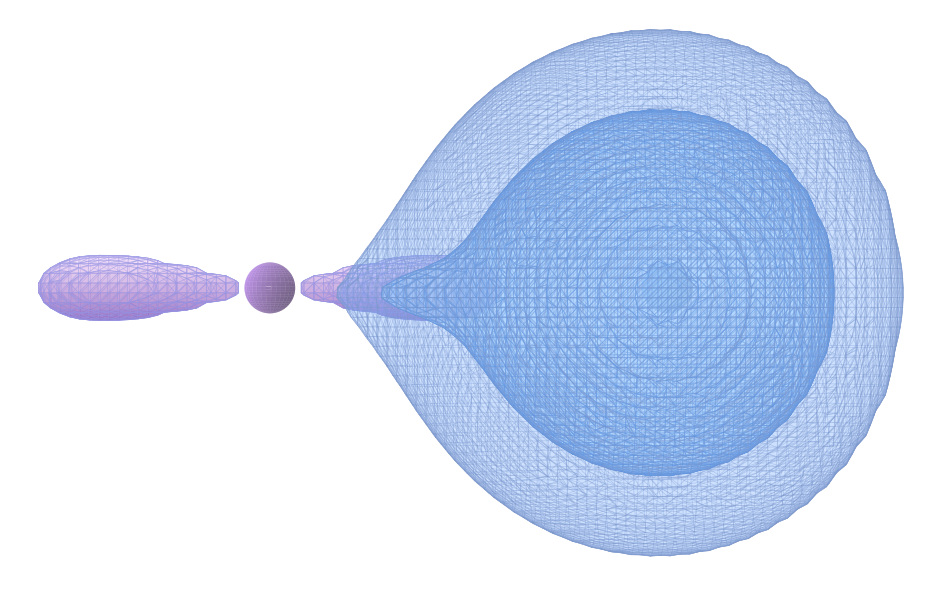
3D numerically simulated image of a Hydrogen-like field entering into a p_x lobe’s field, from Figure 7.
Source Code and Supporting Materials
Currently CGI Internal.
Summary and Notes
Document role:
This paper applies Coherence Geometry (CG) to the problem of chemical bonding, modeling atoms as continuous amplitude and phase fields evolving under a shared energy functional. Bond formation is treated as a real-time process of phase alignment, curvature minimization, field deformation, and coherent bridge formation.
The paper extends the orbital morphogenesis work of “Atomic Orbitals via Coherence Geometry” into interacting atomic systems. Simulations of symmetric and asymmetric configurations, including H2 and HF, show visible amplitude bridges, field deformation, directional lobe capture, and bond localization behavior.
Core results:
The simulations demonstrate several coherence-geometric bonding behaviors:
- symmetric amplitude-bridge formation in H2-like systems;
- asymmetric lobe capture in HF-like systems;
- lobe locking, in which a hydrogen field is drawn into a pre-formed fluorine
lobe; - spin-dependent bonding suppression when spin is modeled as a continuous
torsional phase field; - a real-space reinterpretation of Pauli-like exclusion as curvature tension
and phase misalignment rather than symbolic exclusion.
Scope:
This document should be read as a geometric and simulation-driven CG study of bond formation. It focuses on phase alignment, amplitude bridging, lobe locking, spin-channel interaction, curvature tension, and bond-like field stabilization. Broader chemistry-scale modeling, quantitative energy calibration, spectral prediction, and molecular engineering applications are left to future work.
Historical and framework context:
This paper was originally written in September 2025 and updated in May 2026 for public release with current Zenodo references where available. It belongs to the simulation-driven chemistry phase of the Coherence Geometry research corpus. The technical content and simulation results are preserved as an original 2025 CG bonding study, while the reference layer has been updated to connect the paper to the current public CG corpus.
Relation to related CG work:
This paper is closely related to “Atomic Orbitals via Coherence Geometry,” which develops the orbital-like field structures used as precursors for bonding. It also relates to CG work on protein folding, internal refinement, field dynamics, charge, electromagnetism, and the later Foundations texts, which provide broader context for shared-amplitude, multi-phase, variational, and physical-projection structures.
Related Work
Related records:
Petersen, B. L. (2026). Atomic Orbitals via Coherence Geometry (Version 1.0).
Zenodo.
https://doi.org/10.5281/zenodo.20270492
Petersen, B. L. (2026). Deterministic Protein Folding from Coherence Fields
(Version 1.0). Zenodo.
https://doi.org/10.5281/zenodo.20285351
Petersen, B. L. (2026). Emergent Modular Structure in Coherence-Driven
Oscillator Fields: Spontaneous Phase Alignment and Internal Refinement in
Conservative Lattices (Version 1.0). Zenodo.
https://doi.org/10.5281/zenodo.20282721
Petersen, B. L. (2026). Coherence Geometry Foundations, Part I: Orientation,
Closure, and Algebraic Foundations (Version 0.1). Zenodo.
https://doi.org/10.5281/zenodo.20156532
Petersen, B. L. (2026). Coherence Geometry Foundations, Part II: Physical
Projections (Version 0.1). Zenodo.
https://doi.org/10.5281/zenodo.20156997