

Emergent Modular Structure in Coherence-Driven Oscillator Fields: Spontaneous Phase Alignment and Internal Refinement in Conservative Lattices
Internal ID: CGI-RSR-000025
Author(s): Barry L. Petersen
Document Type: Research Paper
Publication Date: May 2026
Original Creation Date: April 13, 2025
Revised Document Date: N/A
Status: Public
Domains: Pattern Formation, Physics, Information & Computation
Sub-Domain: Coherence Dynamics, Field Dynamics
Research Topics: Coherence Dynamics, Numerical Pattern Formation Study
Abstract
We report the spontaneous emergence of localized wave events in conservative oscillator lattices governed by variational phase dynamics. These waves arise not from imposed inputs or engineered oscillations, but from the system’s own internal alignment geometry. As phase attractors begin to stabilize, regions of residual curvature occasionally collapse and emit coherence waves—compact, radially propagating realignment fronts that refine basin boundaries and accelerate convergence. Despite being implemented in discrete, deterministic systems with no stochasticity, these waves preserve coherence over distance and leave behind smoothed, lower-energy field configurations. They act as internal correction mechanisms: neither symbolic nor supervised, but emergent from the constraints of the field. The model demonstrates that even in single-phase systems, modular segmentation and internal refinement can arise purely from local alignment dynamics. In high-dimensional extensions—such as those used in CDI inference systems—this behavior becomes a scalable mechanism for unsupervised structure formation, analog memory stabilization, and generalization. The results point to a new class of geometry-driven refinement phenomena, and a novel substrate for analog computation based on energy minimization and coherence propagation.
Available Document
DOI: 10.5281/zenodo.20282721
Citation:
Petersen, B. L. (2026). Emergent Modular Structure in Coherence-Driven Oscillator Fields: Spontaneous Phase Alignment and Internal Refinement in Conservative Lattices. Zenodo. https://doi.org/10.5281/zenodo.20282721
Representative Figure
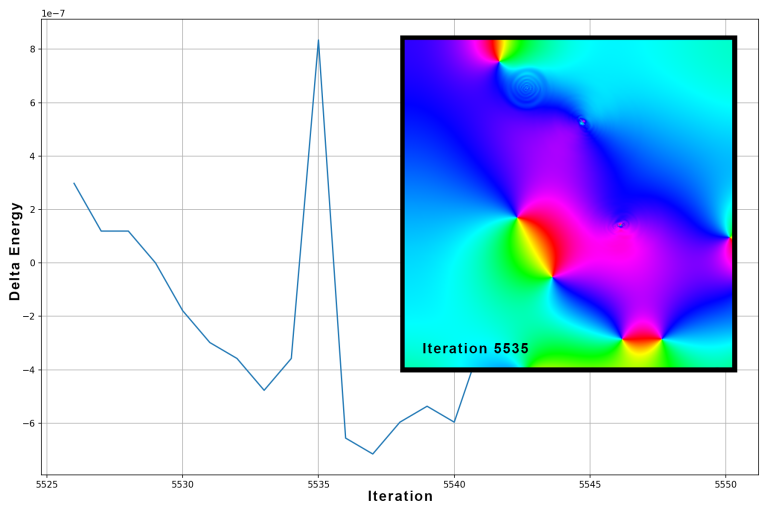
Zoomed-in plot of energy delta over iterations 5525–5550, showing a distinct spike at iteration 5535. The inset shows the corresponding simulation frame, where two localized points of phase disruption appear simultaneously—marking the onset of a ripple-driven correction event. Although ripples at that location are not yet visible, the system responds immediately at the energetic level. Another ripple can be seen near the top of the field.
Source Code and Supporting Materials
File included:
Emergent_Modular_Structure_in_Coherence_Driven_Oscillator_Fields.pdf
File description:
PDF paper describing ripple events, spontaneous phase alignment,
coherence-wave propagation, internal refinement, and modular structure in
conservative oscillator lattices.
Computational materials included:
- Soliton_HD_Video_Creator.ipynb
Jupyter notebook used to generate the phase-field evolution frames associated
with the attractor-basin formation figures. The notebook visualizes
evolution from random initialization toward modular coherence, with hue
representing local phase value. - Soliton_Cuda_Video_Frame_Creator-InteractiveRadius.ipynb
Jupyter notebook used to generate close-up ripple morphology and
before/after refinement frames. The notebook supports interactive radius
selection and CUDA-based frame generation for ripple visualization.
Reproducibility note:
The notebooks are included as research artifacts associated with the paper and
its figures. They are provided for inspection, experimentation, and partial
reproduction of the visual results. They are not packaged as maintained
software. Local paths, environment setup, GPU/CUDA availability, plotting
settings, and execution order may require adjustment. No public technical
support is implied.
Summary and Notes
Document role:
This paper studies the spontaneous emergence of modular attractor basins in conservative oscillator lattices governed by coherence-driven phase alignment. Starting from random initialization, the field relaxes into stable, segmented, memory-like coherence structures without supervision, training, stochastic sampling, symbolic encoding, or central control.
The primary phenomenon is basin formation: deterministic local alignment under constraint produces robust modular regions that serve as geometric representations of self-organized coherence.
The paper also documents a secondary effect: ripple-like coherence waves that arise from trapped phase tension after attractor structure begins to form. These compact, radially propagating realignment fronts refine basin boundaries, redistribute alignment gradients, smooth field configurations, and improve convergence. They are not required for structure formation, but appear naturally as internal correction events during field optimization.
Together, basin formation and ripple correction show how structured memory and refinement dynamics can arise from local coherence constraints. The included notebooks generate the phase-field evolution, attractor-basin, ripple-morphology, and before/after refinement figures used in the paper.
Historical and framework context:
This paper is released in its original April 2025 form. It predates the later public organization of the CG canon records and Foundations texts. Some references cite early foundational manuscripts as they existed at the time of writing. Later canon and Foundations materials provide the current public reference layer for the underlying variational, stability, and multi-phase coherence framework.
Related Work
Petersen, B. L. (2026). Coherence Geometry Foundations, Part I: Orientation,
Closure, and Algebraic Foundations (Version 0.1). Zenodo.
https://doi.org/10.5281/zenodo.20156532
Updated Equivalent References:
[1] Petersen, B. L., & Johnson, R. K. (2026). A Variational–Relaxation Framework for Coherence-Driven Structure Formation. Zenodo. https://doi.org/10.5281/zenodo.20120588
[2] Petersen, B. L. (2026). Mathematical Foundations of Coherence Formation and Stability. Zenodo. https://doi.org/10.5281/zenodo.20116648
[3] Petersen, B. L. (2026). A Multi-Phase Extension of Complex Numbers and the Global Coherence Theorem. Zenodo. https://doi.org/10.5281/zenodo.20116654