

Black Holes and Horizon Structure
This research area studies horizon-like behavior in Coherence Geometry, including curvature trapping, boundary emission, information flow, gravitational analogues, and radiative flux from coherence-bound regions. Rather than treating horizons only through the standard spacetime or semiclassical formulations, these papers investigate how horizon-like interfaces can arise from internal amplitude-phase dynamics, curvature strain, coherence confinement, and projection.
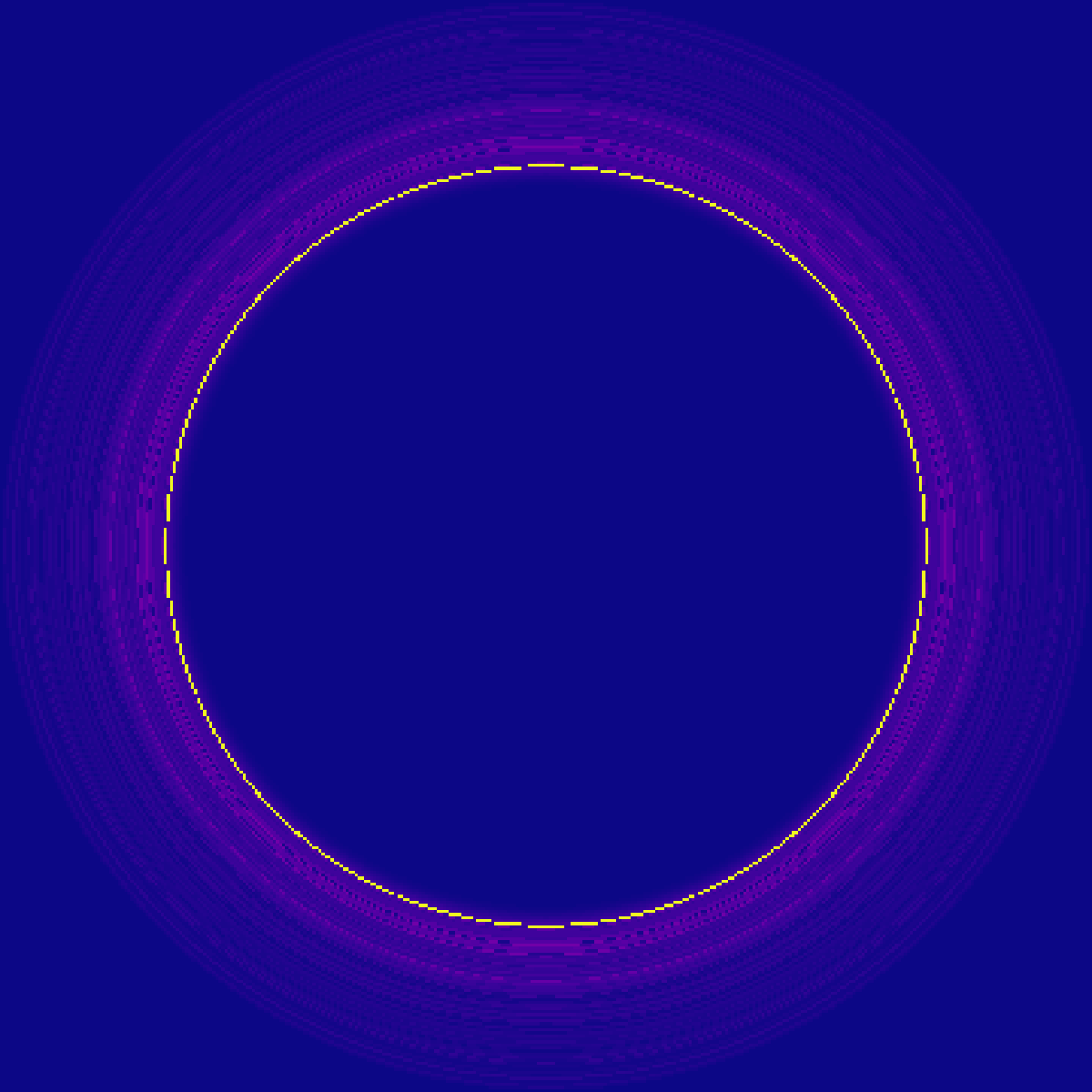
Representative peak-response frame from the horizon-like coherence simulation. A strong boundary-localized response forms around the constrained core, with radiative structure extending into the surrounding field. The associated paper measures this response using the radial Noether energy current, verifies \(P\propto R^{-2}\) across a scale-covariant radius family, and confirms ordered outward propagation in an independent transport control.
The goal is to understand which features of black-hole and horizon physics may reflect more general geometric mechanisms within structured coherence fields.
Publication List
-
A Minimal Self-Organizing Source Model for Emergent Horizons and Radiative Scaling
CGI-RSR-000035 | Horizon calculations ordinarily begin after a horizon-bearing background, flow, or characteristic structure has already been specified. Here we ask an upstream question: can a minimal deterministic source generate its own scale, transition, one-way characteristic surface, intrinsic dynamics, and radiative response?
-
Horizon-Like Emission from Curvature-Bound Coherence Fields
CGI-RSR-000023 | We investigate horizon-like emission from a deterministic, curvature-bound coherence field within the Coherence Geometry (CG) framework. A reduced multi-phase model with ordinary wave propagation, phase locking, and higher-spatial-derivative curvature stiffness is evolved outside a prescribed spherical core. Energy transport is measured using the complete radial Noether current.