

Toward a Mechanism of Charge: A Criterion-Based Approach Using Coherence Geometry
Internal ID: CGI-RSR-000018
Author(s): Barry L. Petersen
Document Type: Research Paper
Publication Date: May 2026
Original Creation Date: June 2025
Status: Public
Domains: Physics
Research Topics: Electromagnetism, Mechanism of Charge, Electric charge, Emergent charge
Abstract
This paper presents a geometric mechanism for electric charge, grounded in localized curvature within a structured coherence field rather than in fundamental particles. Using a multi-channel phase framework, we define alignment and torsional fields \((\theta^{(1)}, \theta^{(2)})\) constrained by a shared amplitude envelope \(A(x, y)\). Through numerical simulation, we test five criteria for emergent charge behavior: field sourcing, mobility, polarity, classical field recovery, and topological identity. Curvature in the alignment field \(\theta^{(1)}\) induces persistent structures in the torsional field \(\theta^{(2)}\), reproducing monopole- and dipole-like field patterns without external sources. Coherent defects preserve their internal geometry under translation and exhibit sustained influence consistent with classical charge motion. Oppositely signed curvature configurations yield antisymmetric torsional responses. Static configurations recover divergence and field flow consistent with electrostatics, and global topological winding in \(\theta^{(1)}\) remains conserved under dynamic deformation. Together, these results demonstrate that charge-like behavior can emerge entirely from internal phase geometry, offering a non-particle origin for classical electrostatic phenomena.
Available Document
DOI: 10.5281/zenodo.20229561
Citation:
Petersen, B. L. (2026). Toward a Mechanism of Charge: A Criterion-Based Approach Using Coherence Geometry (1.0). Zenodo. https://doi.org/10.5281/zenodo.20229561
Representative Figure
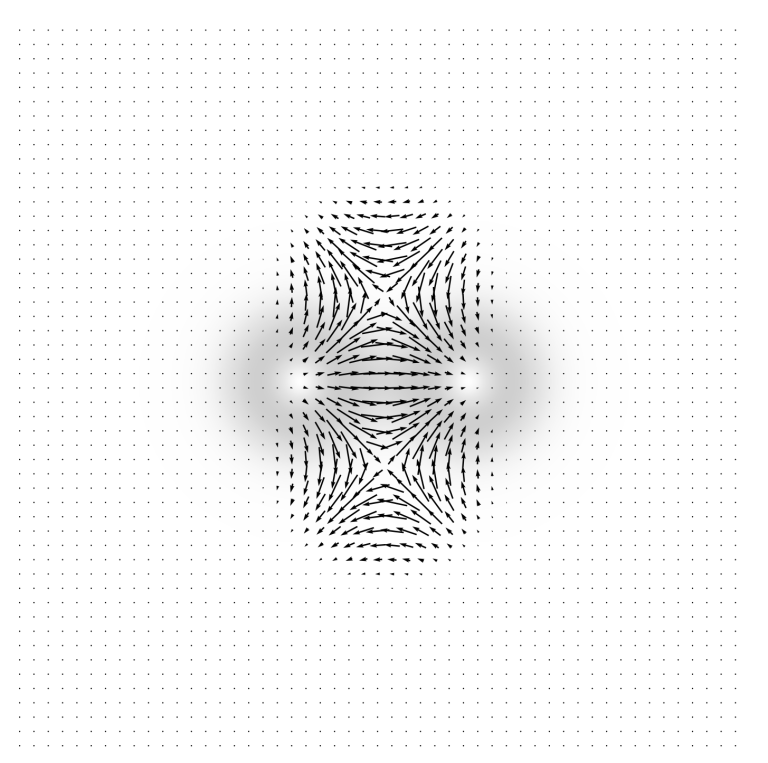
Coherence-generated dipole field. The vector field (\(\vec E = A\nabla\theta^{(1)}\)) forms a dipole-like pattern directly from the geometry of the alignment field. In this model, polarity is indicated by field flow, while the source structure arises from internal coherence curvature rather than externally inserted charges.
Source Code and Supporting Materials
Simulation code is not included in this release. The paper reports the model, criteria, selected numerical outputs, and geometric interpretation. Any underlying computational materials are internal research artifacts and are not packaged as public software. No public technical support is implied.
Summary and Notes
Reader orientation:
This paper presents the geometric and numerical mechanism of charge in Coherence Geometry. It identifies the behavioral criteria that charge-like structure must satisfy, including field sourcing, mobility, polarity, classical field recovery, and topological identity.
The later Foundations, Part II treatment uses this geometric mechanism as the
basis for an algebraic reconstruction of emergent charge and Maxwell-type field
structure. The two presentations are complementary: this paper shows the
mechanism visually and geometrically, while the textbook develops the
corresponding algebraic formulation.
Related Work
Petersen, B. L. (2026). Coherence Geometry Foundations, Part II: Physical
Projections (Version 0.1). Zenodo.
https://doi.org/10.5281/zenodo.20156997
Petersen, B. L. (2026). Electromagnetism from Coherence Geometry: Field Alignment, Wave Propagation, Lorentz Interactions, and Coherence-Driven Radiation (1.0). Zenodo. https://doi.org/10.5281/zenodo.20230100