

Quantum Chemistry
This research area studies how quantum-chemical structures may appear as projections of Coherence Geometry. Current work focuses on orbital morphogenesis, nodal topology, and bonding behavior arising from curvature-driven relaxation, phase relations, amplitude constraints, and coherent field interaction.
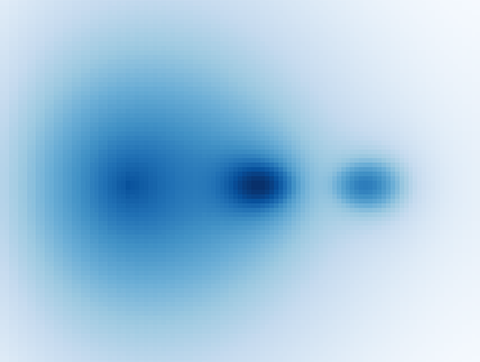
A geometric field showing amplitude intensity building in and around the location of one lobe of a p_x orbital in a coherence-geometric Hydrogen Fluoride bonding simulation.
The papers in this area should be read as geometric and simulation-driven investigations of chemical structure. They explore how familiar orbital and bonding patterns can form from coherence dynamics, while broader chemistry-scale modeling, spectral calibration, and predictive electronic-structure applications remain open directions for future work.
Publication List
-
Atomic Bonding via Coherence Geometry
CGI-RSR-000027 | This paper applies Coherence Geometry — a deterministic, field-based framework — to the problem of chemical bonding, modeling atoms as continuous amplitude and phase fields evolving under a shared energy functional. Unlike traditional quantum mechanics, which describes bonding via probabilistic wavefunction overlap and operator constraints, Coherence Geometry treats bond formation as a real-time…
-
Atomic Orbitals via Coherence Geometry
CGI-RSR-000024 | This paper introduces a geometric framework for the spontaneous emergence of atomic orbital structures from curvature-driven field dynamics, independent of quantum mechanical postulates. Within Petersen’s Coherence Geometry (CG) framework, orbitals arise as metastable attractors in a real-valued amplitude field, shaped by angular tension gradients and curvature bifurcations.